
Classification of Crude Drugs
INTRODUCTION
The crude drugs obtained from different natural sources are used in treatment of wide spectrum of diseases. For their adequate study, it is necessary to arrange them in scientific and systematic manner. Their huge number and varied occurrence make it difficult to put them in a uniform pattern.
For pharmacognostic study, crude drugs can be arranged in one of the following classes.
1. ALPHABETICAL CLASSIFICATION
Either the Latin names or English names of drugs are considered for this purpose of classification. This classification is adopted by the following books.
1. British Pharmacopoeia (English).
2. British Pharmaceutical Codex (English).
3. United States Pharmacopoeia (English).
4, Pharmacopoeia Internationalis (Latin).
5. Indian Pharmacopoeia (English).
6. British Herbal Pharmacopoeia (English).
However, this type of classification does not help in distinguishing the drugs from plants, animals or mineral sources and also does not indicate whether they are norganiz or norganized.
2. TAXONOMICAL CLASSIFICATION
It is a type of biological classification and restricted mainly to crude drugs from plant source. It indicates the phylum, class, sub-class, order, family, genus and species of the crude drugs. It is criticized for its failure to norganiz the norganiz or norganized nature of crude drugs in their morphological studies. The taxonomical system of classification can be elaborated further as follows
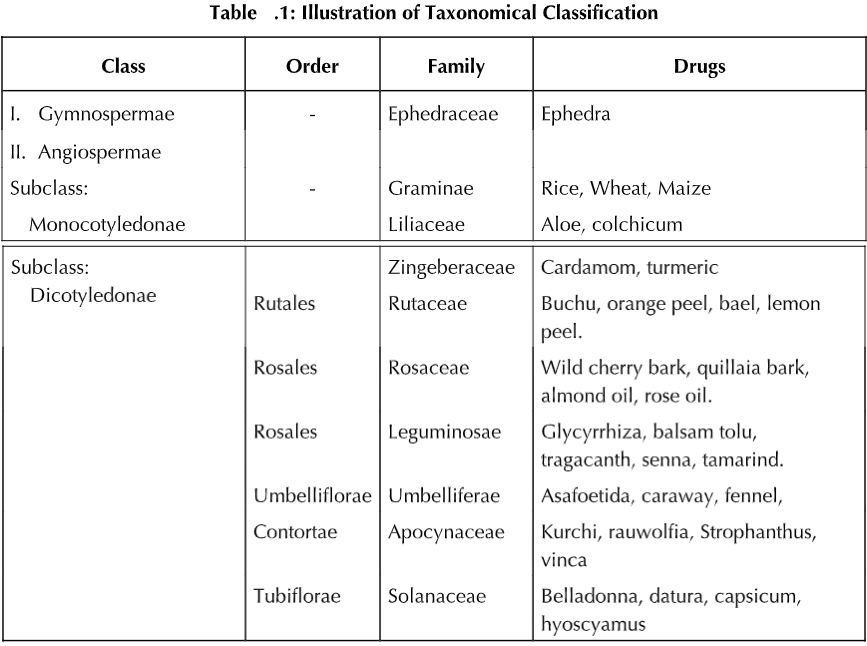
Animal drugs are classified as fishes, arthropods, mammals etc. Most of the crude drugs do not represent whole plants or animals. Minerals get excluded from this classification.
3. MORPHOLOGICAL CLASSIFICATION
In this type of classification, the crude drugs are divided into the parts of plants like leaves, fruits, flowers, woods, barks, dried lattices, extracts, gums, etc. (Table 2).
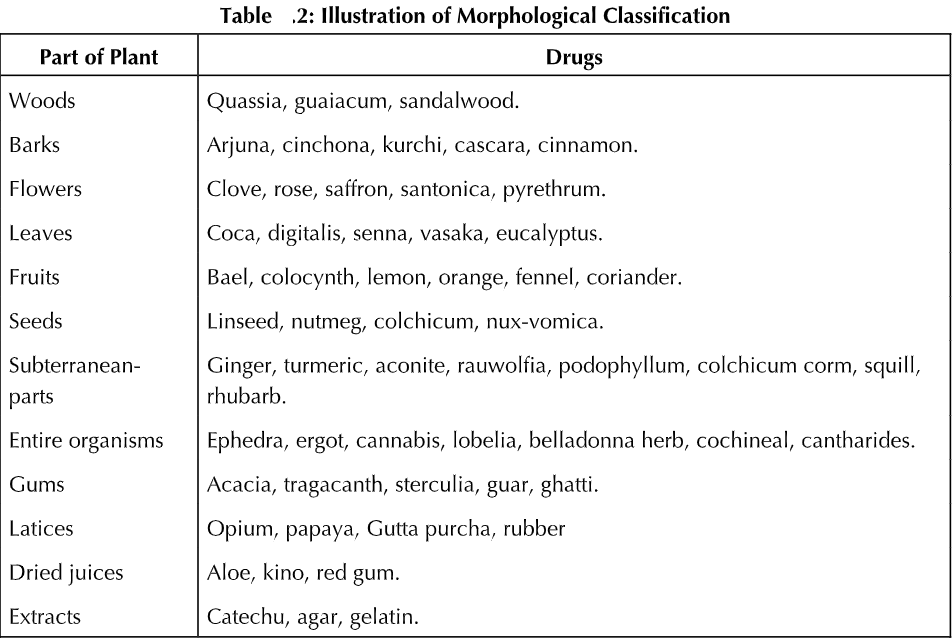
This type of classification is more convenient for practical purposes. Even if the chemical nature is not known, a drug can be studied for pharmacognostic character. This type of classification is very useful in identifying the adulterants used.
Since some drugs do not represent the exact morphological part, it is difficult to classify them properly. In the natural state, crude drugs from plant source can be readily distinguished. But operations like collection, drying, preparation for the market produce distortion of the natural form making their recognition very difficult. The morphological characteristics, however, do not reflect on chemical composition and biological behaviour of a crude drug. Animal drugs and minerals are difficult to classify by this method.
4. PHARMACOLOGICAL CLASSIFICATION
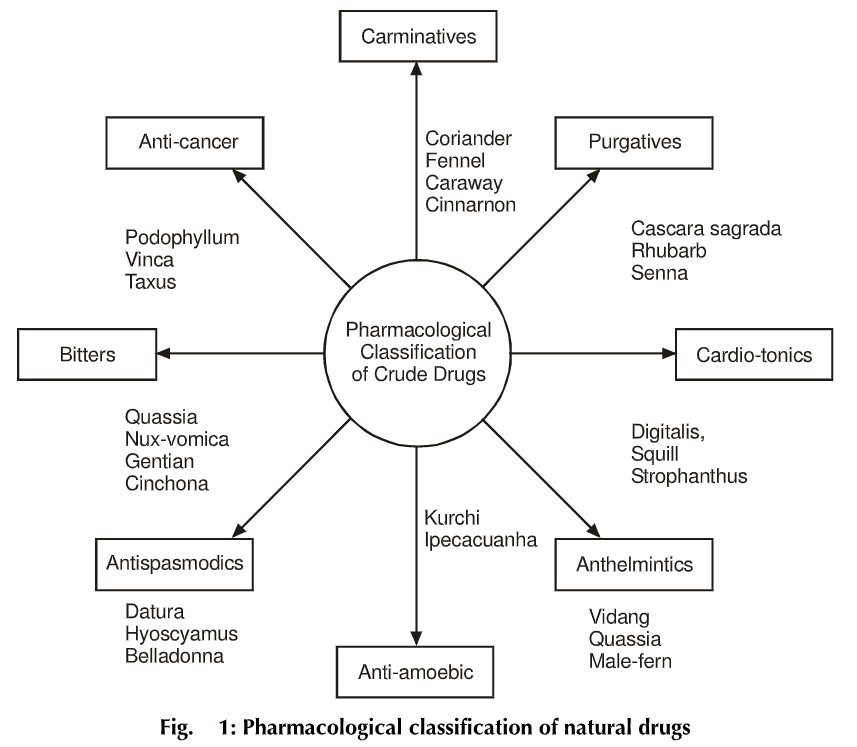
Under this system of classification, the drugs are classified according to pharmacological actions of their chief constituents (Fig. 1). Thus, the drugs similar in their action are put together, regardless of their morphology, biological behaviour and chemical nature (Table 3).
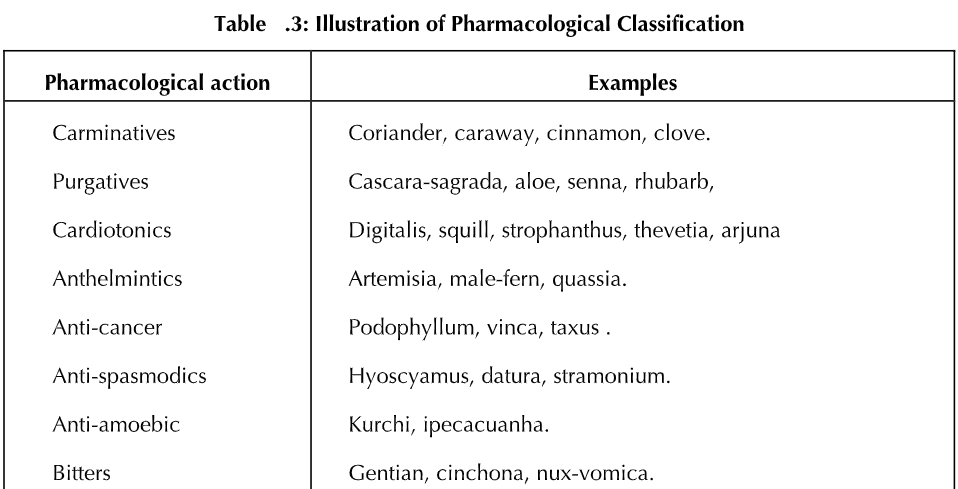
The special advantages which the method enjoys is that, even if the contents of the crude drugs are not known, they can be classified properly on the basis of therapeutic or pharmacological property.
Crude drugs used as Pharmaceutical aids do not find any place in this class.
However, the drugs which are dissimilar in their action of mechanism, even though their therapeutic effect is same (e.g. bulk purgatives, irritant purgatives etc.) are put together. It is also possible that the same drug with two different actions on the body, may be classified separately at both the places. For example, cinchona is grouped as antimalarial and bitter and nux-vomica as bitter and stimulant.
5. CHEMICAL CLASSIFICATION
This type of classification is applicable to crude drugs containing similar type of chemicals (Table 4). It is useful for phytochemical studies of crude drugs.
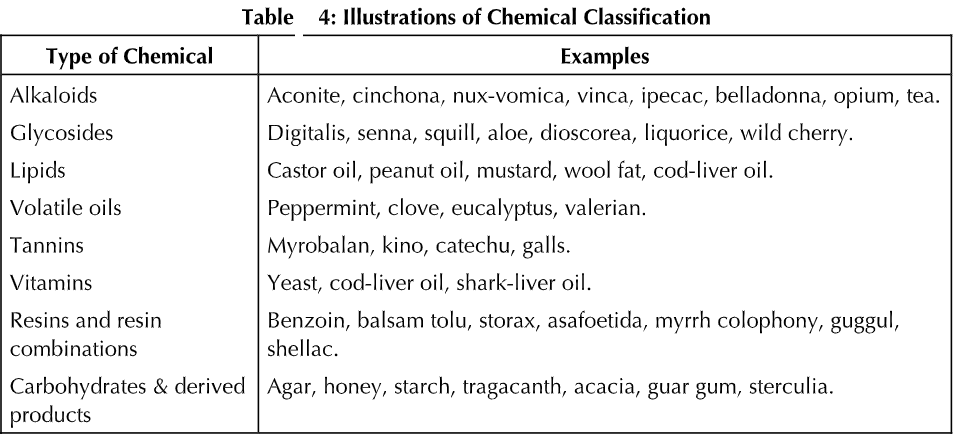
However, this type of classification fails in proper placement of drugs containing two different types of chemicals. For example, certain drugs are found to contain alkaloids and glycosides (cinchona), fixed oil and volatile oil (nutmeg), fixed oil and enzyme (bitter almond) together and hence makes it difficult to categorize them properly.
Even though much importance is attached to this type of classification at present, morphological system is the method of choice for practical purposes.
6. CHEMOTAXONOMICAL CLASSIFICATION
This is a recent approach to the study of the classification of crude drugs, wherein equal importance is given to their taxonomy and biogenesis. The phytochemical screening of several drugs has revealed that there is a close relationship between chemical contents of the plant and its taxonomical status. Earlier workers classified the algae into red, green and brown varieties, but it was only during last three decades that modern methods of extraction and characterization of Phyto-constituents have led to the chemical screening of many thousands of plant species. The status of berberine, rutin and other flavonoids in species of higher plants is of chemotaxonomical significance.
Comments
Post a Comment